
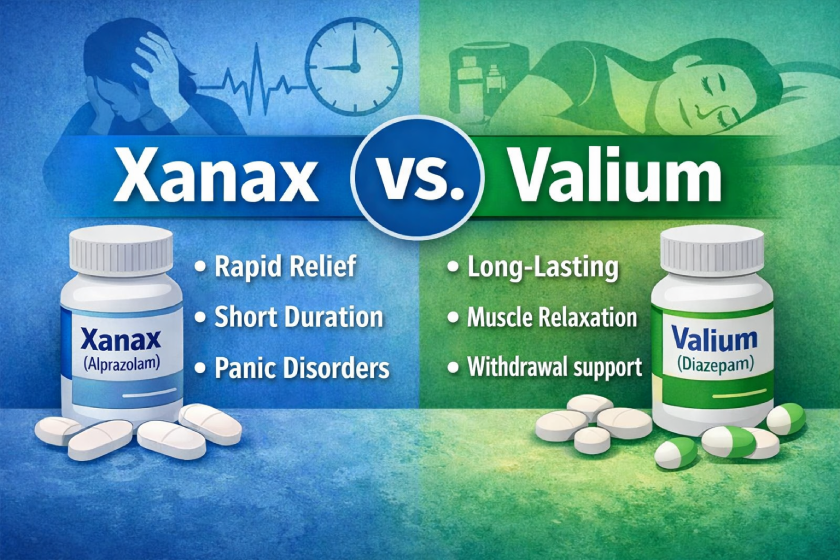
Anxiety disorders affect millions of people worldwide, and benzodiazepines are commonly prescribed for short-term symptom relief. Two of the most recognized medications in this class are Xanax and Valium. While they share similar calming effects, they differ in how quickly they work, how long they last, and how healthcare providers typically use them.
This guide explains the clinical and practical differences to help patients better understand treatment options.
What Are Benzodiazepines?
Benzodiazepines are central nervous system depressants that enhance the activity of gamma-aminobutyric acid (GABA), a neurotransmitter that reduces brain activity. This produces calming, anti-anxiety, muscle-relaxing, and sedative effects.
They are commonly prescribed for:
- Anxiety disorders
- Panic attacks
- Muscle spasms
- Seizure disorders
- Alcohol withdrawal
- Short-term insomnia
Key Differences Between Xanax and Valium
1. Active Ingredients
- Xanax contains alprazolam
- Valium contains diazepam
Both medications affect GABA receptors but differ in pharmacokinetics and duration.
2. Onset of Action
Xanax: Rapid onset, often within 15–30 minutes. Commonly used for sudden panic symptoms.
Valium: Fast onset but slightly slower than Xanax, typically 30–60 minutes.
3. Duration of Effects
Xanax: Short-acting; effects last about 4–6 hours.
Valium: Long-acting; effects may persist 20–70 hours due to active metabolites.
4. Common Medical Uses
Xanax is typically prescribed for:
- Panic disorder
- Acute anxiety episodes
- Short-term anxiety treatment
Valium is commonly prescribed for:
- Generalized anxiety
- Muscle spasms
- Seizure disorders
- Alcohol withdrawal
- Pre-procedure sedation
5. Half-Life
- Xanax half-life: approximately 11 hours
- Valium half-life: 20–50 hours, with prolonged activity from metabolites
6. Dependence and Withdrawal Risk
Both medications carry risks of tolerance and dependence. However, shorter-acting benzodiazepines like Xanax may produce stronger rebound anxiety and withdrawal symptoms if stopped abruptly.
Choosing Between Xanax and Valium
When Xanax May Be Preferred
- Rapid relief is needed
- Panic attacks are sudden and severe
- Short-term treatment is planned
- A medication with shorter duration is desired
When Valium May Be Preferred
- Long-lasting symptom control is needed
- Anxiety is chronic
- Muscle relaxation is required
- Managing alcohol withdrawal
- Tapering off benzodiazepines
Safety Considerations
- Use only under medical supervision
- Avoid alcohol and other sedatives
- Do not drive until effects are known
- Long-term use is generally discouraged
- Never stop abruptly without medical guidance
Patient FAQ
Which works faster, Xanax or Valium?
Xanax typically works faster, often within 15–30 minutes, while Valium usually takes 30–60 minutes.
Which medication lasts longer?
Valium lasts significantly longer and may remain active for up to several days in some individuals.
Is one safer than the other?
Both are safe when used as prescribed, but risks increase with long-term use or misuse.
Why would a doctor switch someone from Xanax to Valium?
Valium’s longer duration makes it useful for tapering and for conditions requiring sustained relief.
Can I stop taking these medications suddenly?
No. Sudden discontinuation may cause withdrawal symptoms and should be avoided.
Final Thoughts
Both Xanax and Valium are effective benzodiazepines, but they serve different therapeutic roles. Xanax provides fast, short-term relief for acute symptoms, while Valium offers longer-lasting effects and broader clinical applications. Treatment decisions should always be individualized and guided by a qualified healthcare professional.